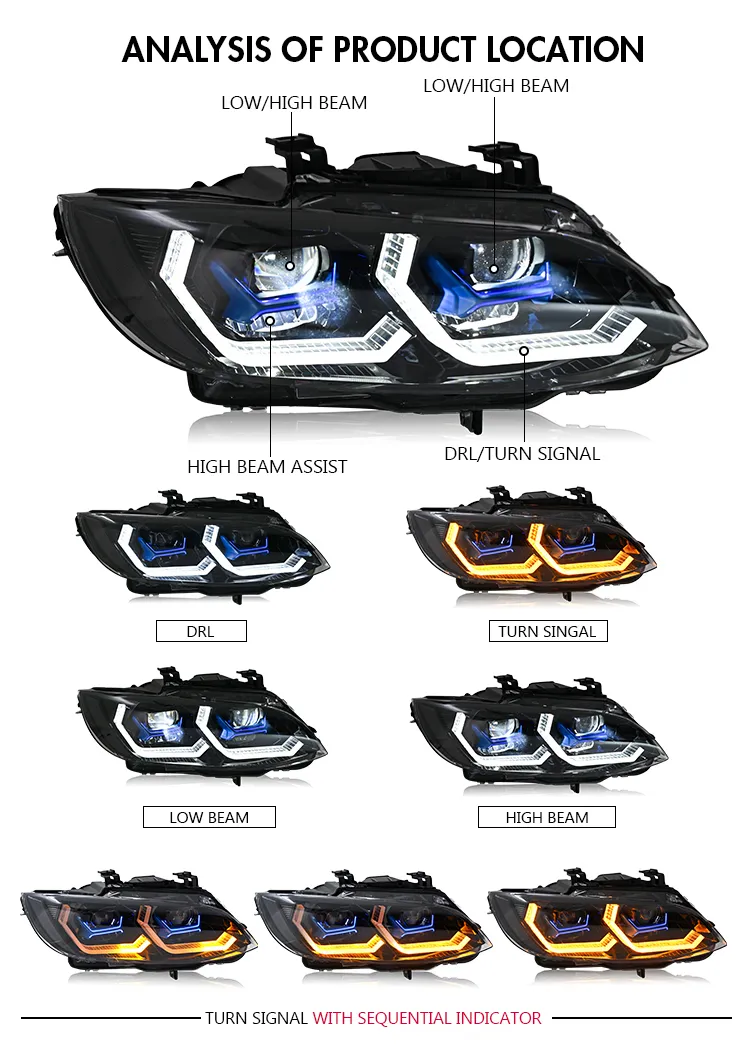


Na indústria de peças automotivas, Car Faróis are undoubtedly one of the components with the highest technical content and safety requirements. Whether you are doing aftermarket modifications or looking for original factory replacement parts, the lighting effect of the headlamps will affect driving safety.
Nowadays, when many people talk about car headlights, they think that the brighter the car lights are, the better. However, in the traffic regulations of various countries (such as the GB 7258 standard in China), the requirements for car lights are not that the brighter, the better. Lights that are too bright can affect the drivers of other vehicles. Therefore, the headlights of current cars must meet three strict standards. These strict regulations are all to ensure one’s own driving safety at night and not to interfere with the driving of others.
The first regulation: Strict requirements for the illumination distance of car headlights
The faster a car travels, the longer the braking distance. Therefore, the law stipulates that the illumination distance of high beams must exceed 100 meters, so that you have sufficient reaction time during driving. The requirement for low beams is generally around 50 meters, mainly for driving in well-lit environments to clearly see the road conditions ahead.
The second regulation: Anti-glare for vehicle headlights
When driving at night, if the driver’s vision is suddenly blinded by a white light, it is extremely dangerous. Therefore, it is stipulated that both the high beams and low beams of a car’s headlights must strictly meet the anti-glare requirements. When the light hits a wall, there must be a very clear demarcation line between the bright and dark areas. The significance of this line is that the light beam is precisely positioned just below the line of sight of oncoming drivers. This ensures that the driver can see the road clearly while not dazzling others.
Third regulation: Penetration of vehicle lights
In simple terms, it refers to the luminous intensity of a car’s headlights and their penetration power. For instance, the intensity of the high beam of newly registered vehicles must not be lower than 18,000 cd. If the value is insufficient, although the lights may seem bright under normal conditions, they will be swallowed up in rainy, snowy or foggy weather, leaving the front view blank and making it difficult to see clearly, which can easily lead to traffic accidents.
What are the components inside a car headlight?
In the past, car headlights were just a large glass cover with a light bulb. Nowadays, the design of car headlights is becoming increasingly tech-savvy, but the core components are still these three things working in tandem:
1.Light source
In the past, everyone used halogen lamps (with tungsten filaments and halogen gas), which emitted yellow light. They were cheap but rather dim, and their brightness would decline over time. Later, many people switched to xenon lamps (ESCONDIDO), which were indeed brighter but had a complex structure and required a decoder.
Our primary recommendation is LED light sources. They turn on quickly, have extremely high brightness, and have a long lifespan. For our CoolLamp series of products, we basically use high-power custom automotive-grade LED chips across the board. The core issue we address is how to maintain high brightness while minimizing heat dissipation and light attenuation to ensure long-term stability in use.
2. Reflector
The light emitted by the bulb spreads in all directions. Without a focusing device, it can only illuminate the area within two or three meters in front of the vehicle. The most basic design is to add a reflector to collect the scattered light and direct it forward.
This is also the reason why many car owners fall into a trap: they directly pull out the original halogen bulb and replace it with a super-bright LED bulb that costs only a few dozen yuan. Because the focus of the light changes, the original car’s reflector bowl can no longer gather the light, and the result is that all the light scatters into the sky. They can’t see the road clearly themselves, and they also blind the drivers coming from the opposite direction.
3. Lens System
To address astigmatism, a more advanced and currently the best-experienced solution is the lens system (Projector).
It has an additional convex lens inside, resembling a glass eyeball, along with a light-blocking plate. The light undergoes multiple convergences and cuts, resulting in an extremely full light pattern with a sharp contrast line between light and dark, as if cut by a knife. This is also the reason why CoolLamp has been persistently focusing on the research and development of LED dual-lens modules. Only with an upper lens can both high brightness and legal compliance be truly achieved.
How to Extend the Lifespan of Car Headlights
No matter how good the car headlights are, it’s all in vain if you don’t pay attention to maintenance and follow the usage norms. When driving, be sure to keep these points in mind:
- Clean the lampshade as soon as it gets dirty: Don’t underestimate the layer of mud, water or dust on the surface of the headlight. It can directly halve the brightness of your car’s headlights and seriously affect your night vision.
- When driving at night and approaching another vehicle, you must switch to low beam headlights at a distance of about 150 meters. This is not only a mandatory requirement of traffic regulations but also to prevent the oncoming vehicle from being unable to see the road clearly and crashing into you.
- Adjusting the light is extremely important: If your car has been driven for a long time and is bumpy, or if you have just replaced the new headlight assembly / lens, you must find a professional to use professional instruments (or on a flat ground facing the wall) to adjust the horizontal angle and height of the light accurately. No matter how good the light is, if the elevation angle is too high, it will still be harmful to both yourself and others.
- Pay attention to aging wiring: If you notice that your car’s lights frequently flicker or dim for no apparent reason, don’t rush to replace the bulbs. Often, it’s due to oxidation at the plug or a loose ground wire, causing unstable voltage. In such cases, cleaning the contacts can solve the problem.
Ultimately, car headlights are not only an exterior part of the vehicle but also a crucial safety feature. Understanding their principles and choosing the right products can truly light the way home.