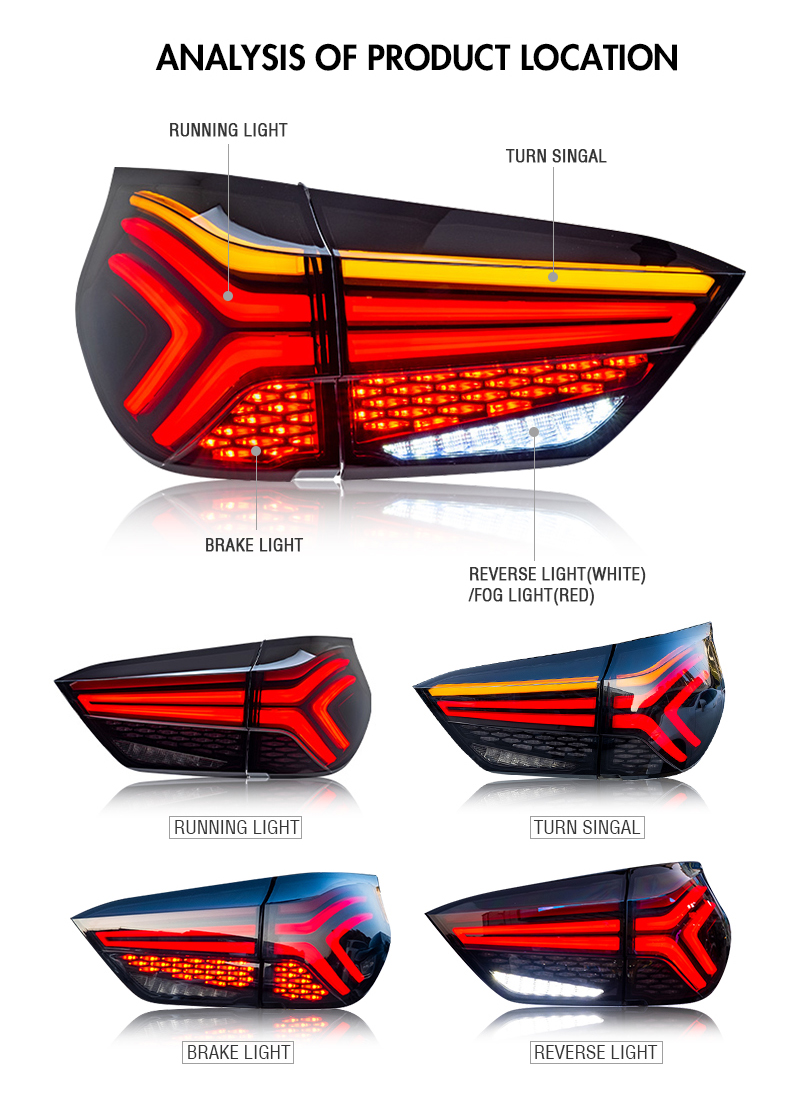


Sur les marchés de l'éclairage automobile et de la modification après-vente, if headlights are the driver’s glasses on the car, then tail lights are equivalent to the driver’s back. The warning effect and compliance of car tail lights directly determine driving safety.
Nowadays, many people only care about the appearance and cool lighting effects when choosing tail lights, paying attention to whether they feature a full-width design or a dynamic sequential effect. However, in traffic regulations around the world (tel que China GB standards, Europe E-Mark certification, or North America’s DOT standards), the requirements for tail lights are far more than just looking cool. Tail lights that are too bright, glaring, or slow to respond can easily cause safety accidents. Donc, modern car tail lights must meet three strict, mandatory standards. These regulations are designed to accurately and safely convey driving intentions under various road conditions.
un. The Three Major Regulations for Car Tail Lights
1. Response Speed
When the driver steps on the brake, the tail lights (feux stop) must light up instantly, and their brightness must be several times that of the nighttime running lights (position lights). During high-speed driving, even a 0.1-second delay in the brake light illuminating will increase the trailing vehicle’s blind coasting distance by nearly 3 meters. Older halogen lamps suffered from delays and short lifespans. High-brightness LED chips, which light up at the microsecond level, have now completely replaced traditional halogen bulbs.
2. Tail Light Colors
Tail light colors are strictly regulated globally, but compliance differences exist across varying countries and regions:
-
Running Lights / Brake Lights / Rear Fog Lights: Must be red. Red light has the longest wavelength and the strongest penetrating power, ensuring that trailing vehicles can still spot your position early in severe weather conditions like rain, snow, or fog.
-
Clignotants (Regional Differences): In the European and Chinese markets, rear turn signals are strictly required to be amber (yellow); whereas in the North American market (complying with DOT standards), red is permitted for the rear turn signals on some vehicles.
-
Reversing Lights: Universally white, serving to illuminate the rear and warn people behind the vehicle.
3. Lighting Effects
While automotive headlights need to focus light to shine far, tail lights only need to diffuse the light. You cannot simply aim for ultra-bright LED tail lights; this can easily cause glare, making it difficult for the driver behind to see clearly. A qualified tail light assembly will utilize precisely calculated light guide bars and diffuse reflection lenses to convert glaring single-point light into a soft, continuous, and uniform light band.
deux. What Are the Core Components of Car Tail Lights?
In the past, car tail lights were merely plastic shells housing bulbs of different colors. Along with automotive development trends, tail light design increasingly focuses on optical technology and electronic integration, but its core still consists of the following three parts working together:
1. Light Source System
Halogen bulbs were widely used in the past; they were cheap but slow to light up and prone to burning out. Today, mainstream products have completely transitioned to LED light sources. High-quality automotive-grade LEDs not only start rapidly and have long lifespans, but can also accommodate various design shapes. The core technical difficulty lies in how to ensure proper heat dissipation within the cramped space of the tail light, minimize light decay, and guarantee the stability of the light during prolonged operation (such as holding the brake during long traffic jams).
2. Optical Conduction and Housing Molds
This is the key to determining the texture of the tail light and its fit when installed on the vehicle. The light emitted by the bulbs must be refracted and homogenized through complex internal reflector bowls, light guides, and optical lenses. Furthermore, the injection molding process and mold precision for the tail light housing demand extremely high standards. If mold development is imprecise, not only will the light pattern scatter and the installation gaps be too large, but it is also highly likely to lead to water ingress later on.
3. Electronic Control and Decoding Modules
Modern tail lights are becoming increasingly intelligent. To solve the astigmatism or malfunction issues that occur after upgrading halogen tail lights to LED assemblies, they are usually equipped internally with precise circuit boards and decoders. They are responsible for controlling the sequential rhythm of dynamic turn signals, triggering high-frequency flashing during emergency braking, and simultaneously ensuring that the vehicle’s onboard computer does not falsely report a “bulb damaged” fault code.
trois. How to Extend the Lifespan of Car Feux arrière
1. Tail Light Fogging and Water Ingress
Many car owners encounter the issue of fogging and water ingress in their tail lights. Slight moisture caused by temperature differences can usually dissipate through the breathing holes on the back of the tail light. However, if large amounts of water droplets appear inside and do not dissipate over a long period, it is usually due to micro-cracks in the housing or the aging of the factory-sealed adhesive strips. Accumulated water will directly burn out the LED circuit board; once discovered, the unit should be promptly resealed with new adhesive or the entire assembly replaced.
2. Beware of Wiring Aging
If you notice the tail lights flickering inexplicably or dimming when applying the brakes, or if the dashboard emits a “rapid flashing” clicking sound when using the turn signal, do not rush to replace the bulbs. Usually, this is because the tail light plug has oxidized and rusted, or the ground wire is loose, causing voltage instability. Cleaning the contacts or tightening the wiring can often solve the problem.
3. Keep the Lamp Cover Clean
Do not underestimate the mud or dust kicked up at the rear of the car. They can directly obscure the brightness of the brake lights, severely impacting the warning effect. Be sure to clean the surface of the lamp cover thoroughly when washing the car.
4. Perform Regular Walk-Around Inspections
Because tail lights are located at the rear of the vehicle, it is difficult for the driver to immediately notice when they are damaged. It is recommended to park the car in front of a reflective wall or glass window every month and use the rearview mirrors to test the brake, reverse, clignotant, and rear fog lights sequentially, ensuring that every single light is functioning completely normally.